Invoice Generator for Construction Companies
Construction billing is uniquely complex — progress payments, retainage holdbacks, subcontractor pass-throughs, and lien waiver requirements. Generate structured invoices that keep your projects funded and your paperwork audit-ready.
Create Your First Invoice — Free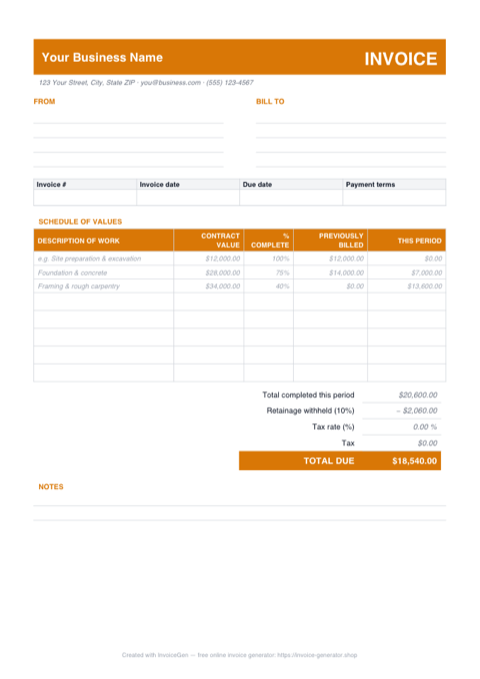
Download a Free Construction Invoice Template
Pre-built for how construction companies bill — grab it in the format you already work in. No sign-up required.
Format guides: PDF guideExcel guideWord guide
Invoicing Challenges for Construction Companies
AIA-Style Progress Billing
Many commercial projects require AIA G702/G703 formatted applications for payment. These involve schedule-of-values breakdowns, percentage-complete tracking, and cumulative billing — far beyond a simple invoice.
Subcontractor Cost Pass-Through
General contractors bill for their own work plus subcontractor costs. Each sub’s charges need to be clearly represented on the invoice so the owner can track costs by trade and verify the work was completed.
Lien Waiver and Compliance Requirements
Many states require lien waivers to accompany each payment application. Your invoicing workflow needs to account for collecting and submitting these documents alongside every billing cycle.
Construction Companies Invoicing Tips
Use a Schedule of Values
Break the total contract amount into a schedule of values by trade or phase. Each invoice shows the percentage complete and amount billed for each line item, giving the owner full cost visibility.
Track Retainage Cumulatively
Show retainage withheld on each invoice and maintain a running total. When the project reaches substantial completion, submit a separate invoice to release the accumulated retainage.
Separate GC Fees from Sub Costs
Clearly distinguish your general conditions and overhead from subcontractor pass-through costs. This transparency satisfies owner audits and streamlines payment approvals.
Reference Change Orders by Number
Every approved change order should have its own line in the schedule of values. Reference the CO number, date approved, and amount so the owner can reconcile each change against their records.
What to Include on a Construction Companies Invoice
- Project name, number, and site address
- Application number and billing period
- Schedule of values with percentage complete
- Work completed this period by line item
- Materials stored on-site (not yet installed)
- Retainage withheld (current and cumulative)
- Approved change order amounts
- Subcontractor cost breakdown by trade
Ready to invoice your next project owner?
Create Your Invoice NowFrequently Asked Questions
What is AIA-style billing in construction?
How does retainage work on construction invoices?
How do I bill for subcontractor work as a general contractor?
Do I need lien waivers with my construction invoices?
Construction Invoice Template Format Guides
Each guide covers when that format works best, format-specific tips, and the free download.
Related Templates & Tools
Construction Invoice Template
Free construction invoice template for progress billing, change orders, and materials tracking. Generate professional PDF invoices for any job size.
Cleaning Services Invoice Generator
Free invoice generator for cleaning services. Manage recurring billing, multiple locations, supply costs, and service packages with professional PDF invoices.
Tutors Invoice Generator
Free invoice generator for tutors. Track hourly sessions, manage cancellation fees, offer prepaid packages, and create professional PDF invoices for students and parents.
How to Invoice for a Deposit
Bill an upfront payment or deposit before you start the job — wording and worked examples.