Invoice Generator for Contractors
Contracting jobs run weeks or months, with shifting scopes and multiple payment milestones. You need invoices that can handle progress billing, change orders, and a clear split between materials and labor — without hiring a bookkeeper.
Create Your First Invoice — Free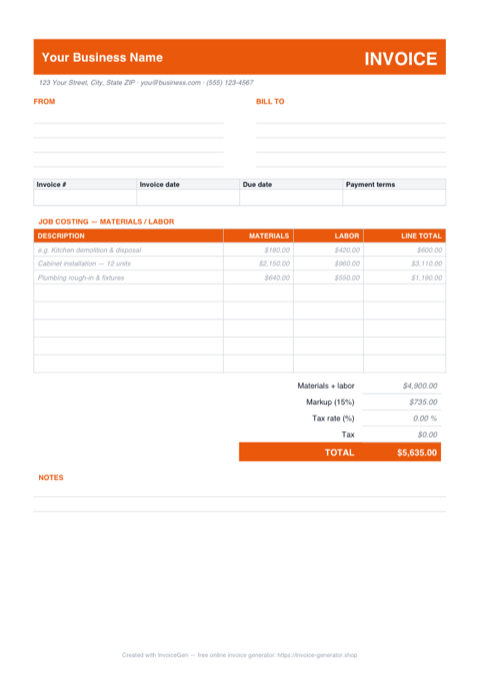
Download a Free Contractor Invoice Template
Pre-built for how contractors bill — grab it in the format you already work in. No sign-up required.
Format guides: PDF guideExcel guideWord guide
Invoicing Challenges for Contractors
Progress Billing for Multi-Phase Jobs
A single invoice at project end is risky for large jobs. You need to bill at each phase — foundation, framing, finishing — and track percentage complete so both you and the client agree on what has been delivered.
Managing Change Orders
Clients request changes mid-project that alter costs and timelines. Without documenting change orders on invoices, you absorb the extra cost or end up in a dispute about what was agreed.
Separating Materials and Labor
Clients and tax authorities both want to see materials and labor broken out. Lumping everything into a single line item creates confusion at tax time and erodes client trust.
Contractors Invoicing Tips
Use Milestone Billing
Define clear milestones (e.g., 30% at demolition complete, 30% at rough-in, 40% at final walkthrough) so cash flows in as work progresses rather than piling up at the end.
Track Retainage Separately
Many contracts hold back 5-10% retainage until project completion. Show retainage as a separate line item on each invoice so both parties can track the cumulative holdback.
Document Change Orders on Invoices
When scope changes, add the change order as a distinct section on the next invoice with its own description, cost, and reference to the signed change order document.
Include Permit and Inspection Costs
If you are passing through permit fees or inspection costs, itemize them separately. Transparency here prevents disputes and shows the client exactly where their money goes.
What to Include on a Contractors Invoice
- Project name and job site address
- Phase or milestone description
- Materials with itemized costs
- Labor hours and rates by trade
- Change order references and amounts
- Retainage held to date
- Permit and inspection fees
- Balance due this period
Ready to invoice your next project owner?
Create Your Invoice NowFrequently Asked Questions
How do contractors handle progress billing?
Should I separate materials and labor on my invoice?
How do I invoice for change orders?
What is retainage and how do I show it?
Contractor Invoice Template Format Guides
Each guide covers when that format works best, format-specific tips, and the free download.
Related Templates & Tools
Contractor Invoice Template
Free contractor invoice template for independent contractors. Handle milestone billing, materials, labor rates, and retainage with professional PDF invoices.
Consultants Invoice Generator
Free invoice generator for consultants. Bill hourly or on retainer, manage scope creep, handle international clients, and create professional PDF invoices in seconds.
Photographers Invoice Generator
Free invoice generator for photographers. Handle session deposits, balance payments, licensing fees, travel expenses, and package pricing with professional PDF invoices.
How to Invoice for a Deposit
Bill an upfront payment or deposit before you start the job — wording and worked examples.