Cleaning Invoice Template — Excel
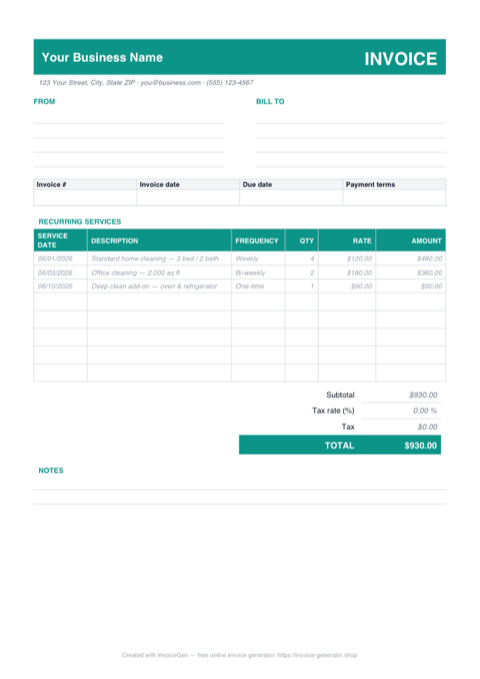
The .xlsx opens straight into a recurring-services table built for cleaning work: a service date column, a frequency column, and example rows — four weekly home visits at $120, a bi-weekly 2,000 sq ft office at $180, and a one-time deep-clean add-on — that you overwrite with your own jobs. Every amount, the subtotal, the tax, and the total are live formulas, so the math keeps up while you type.
Why Excel for Cleaning Services
A frequency column, because cleaning billing repeats
The example rows arrive pre-tagged Weekly, Bi-weekly, and One-time, with qty used as the visit count and rate as the per-visit price. That's the structure recurring contracts need — a month of service reads as three lines, not thirty.
Amount formulas that stay blank until a row is used
Each amount cell holds =IF(OR(qty="",rate=""),"",qty*rate), so the empty rows show nothing instead of a column of $0.00 or errors. The moment you enter both a quantity and a rate, the amount appears and flows into the subtotal.
One editable tax cell drives tax and total
The tax-rate cell beside the subtotal ships at 0% — cleaning labor is untaxed in plenty of states. Type your local rate once and the Tax line (=subtotal × rate) and TOTAL (=subtotal + tax) recompute on their own; there's nothing else to touch.
A subtotal that survives your edits
=SUM() spans all eight line rows, so you can overwrite the samples, clear a row mid-month when a visit is skipped, or reorder entries, and the subtotal tracks whatever is actually filled in.
Invoicing Challenges for Cleaning Services
Recurring Billing Management
Most cleaning clients are on weekly, bi-weekly, or monthly schedules. Generating individual invoices for every visit is tedious, but bundling visits into a monthly invoice requires careful tracking of completed services.
Multiple Locations for Commercial Clients
A single commercial client may have several offices or properties. Each location has different square footage, service frequency, and pricing — and the client often wants one consolidated invoice.
Supply and Equipment Cost Recovery
Cleaning supplies and equipment wear are real costs. Deciding whether to absorb them in your rate or pass them through as line items affects pricing transparency and client expectations.
Cleaning Excel Invoicing Tips
Need more than eight lines? Insert rows above the subtotal
Right-click a row number inside the services table, choose Insert, then drag the Amount formula down from the row above. Because the new row lands inside the existing range, the subtotal's =SUM() expands to include it automatically — no formula editing required.
Create Service Packages
Define packages like Basic (vacuum, dust, mop), Deep Clean (add windows, baseboards, appliances), and Move-Out (everything). Listing the package on the invoice sets clear expectations for what was performed.
Invoice on a Monthly Cycle
For recurring clients, compile all visits into a monthly invoice. List each visit date and service performed so the client can verify against their schedule before paying.
Track Supplies Separately for Large Contracts
For commercial contracts where you supply all materials, add a supplies line item or a flat materials surcharge. This makes your labor rate look competitive while recovering real costs.
Include Scheduling Notes
Note the regular schedule (e.g., every Tuesday and Thursday, 8 AM - 12 PM) on the invoice header. This serves as a service-level agreement and helps both parties confirm the expected cadence.
What to Include on a Cleaning Excel Invoice
- Service package or type performed
- Dates of each cleaning visit
- Property address and square footage
- Number of crew members and hours per visit
- Supplies and materials cost (if passed through)
- Frequency (weekly, bi-weekly, monthly)
- Special services (carpet cleaning, window washing)
- Next scheduled service date
Generate Your Cleaning Excel Invoice Now
Create Invoice — Free, No Sign-UpFrequently Asked Questions
Which versions of Excel open this template?
Does it work in LibreOffice Calc or Apple Numbers?
I typed a quantity but the Amount cell stayed blank — why?
Related Invoice Tools
Cleaning Services Invoice Generator
Free invoice generator for cleaning services. Manage recurring billing, multiple locations, supply costs, and service packages with professional PDF invoices.
Excel Invoice Template
Free Excel invoice template library — download, customize, and send.
Cleaning Service Invoice Template
Free cleaning service invoice template for recurring billing, multiple locations, and service packages. Download professional PDF invoices instantly.
Cleaning Invoice — PDF
Free cleaning invoice template as a print-ready A4 PDF. Sample weekly and bi-weekly service lines show how to bill — print it, fill in the visits, and email it.
Cleaning Invoice — Word
Free cleaning invoice template in Word (.docx). Overwrite the placeholders, add your logo, recolor the teal accents, then save as PDF — or open it in Google Docs.
Construction Invoice — Excel
Free construction invoice in Excel. Schedule of values columns compute each draw, an editable retainage % cell feeds the total due, and rows stay blank-safe.
Contractor Invoice — Excel
Excel contractor invoice with a built-in materials/labor split, blank-safe line formulas, and editable markup % and tax-rate cells. Totals recalculate as you type.
Consulting Invoice — Excel
Free consulting invoice for Excel (.xlsx): a time-tracking sheet where Date, Hours, and Rate feed blank-safe formulas, a Total hours counter, and a tax cell.